


Are teaching and learning policies finally dead, or are schools simply renaming them as playbooks?
If teaching and learning is the core business of schools, then a professional learning playbook must become the engine room, not an optional extra.
From policy to playbook
There is a subtle but significant shift happening in some English schools.
Over the last decade, I have reviewed hundreds of teaching and learning policies from schools across the UK and beyond. Some are beautifully designed. Some are brutally long. Some are research-informed. Some are inspection-facing. Many are well intentioned. Some are not worth the words on paper.
This is the problem.
Most teaching and learning policies describe what leaders want teachers to do. A good teaching and learning playbook shows teachers what effective practice looks like, how it can be adapted, and how the school will rehearse it over time.
A policy explains expectations. A playbook rehearses practice.
That distinction matters. If a document does not help a teacher improve their next lesson, reduce workload, sharpen assessment, support behaviour, or understand the curriculum better, it is probably not a teaching and learning tool. It is an accountability artefact.
Where this thinking began
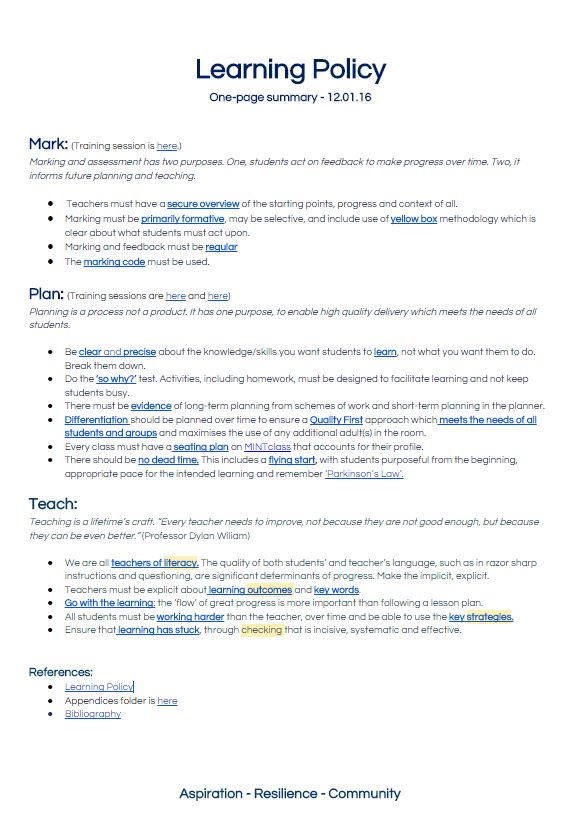
My own thinking started in 2014, when I worked with teaching staff over three years to develop a learning policy from the ground up.
It was not written in isolation. It emerged through weekly professional development sessions, show-and-tell discussions, lesson observations, quality assurance conversations, and the gritty work of asking:
- What does this look like in maths, English, or, art?
- How does this work in a mixed-attainment classroom?
- What does this mean for pupils with SEND?
- Does this strategy reduce workload or increase it?
Eventually, that school policy – documented across this site – became the backbone of Mark. Plan. Teach., first published in 2017, and later updated as Mark. Plan. Teach. 2.0 in 2021.
This one-page summary became our common language: Mark. Plan. Teach.
- Marking informed future planning and teaching.
- Planning was a process, not a product.
- Teaching was clear and precise.
This language became the “hymn sheet” used in CPD, coaching, lesson visits and professional conversations.
Why traditional teaching and learning policies fail
Many teaching and learning policies suffer from the same five problems.
1. They are too long: If a teacher cannot access the policy, they cannot use it. Length often gives leaders a false sense of rigour. In reality, excessive detail makes professional interpretation harder.
2. They are not co-constructed: Teaching staff are often shown the finished document after the thinking has already happened. This is backwards. Teachers need to wrestle with the ideas before they are expected to live them.
3. They reward compliance: Coloured pens, fixed marking frequencies, lengthy lesson observation forms and book scrutiny checklists can create visible consistency. But visible consistency is not the same as learning.
4. They ignore subject nuance: What feedback looks like in Year 2 writing, key stage 3 science, GCSE art or A level history will not be identical. A teaching policy does not mean every teacher doing the same thing.
5. They are disconnected from professional learning: A policy without professional learning is a wish list. It tells teachers what the school values, but does not help them get better.
Coherence, not consistency
For years, schools have chased consistency. Who wouldn’t want to?
But 100 per cent teaching and learning consistency is a myth. It is also, I would argue, the wrong goal. Schools do not need identical classrooms. They need coherent and autonomous classrooms.
Coherence means teachers share a common language, understand the school’s agreed principles, and adapt them intelligently to their subject, phase and pupils. Consistency often asks, “Are all teachers doing the same thing?” Coherence asks, “Do all teachers understand why this matters and how to adapt it well?”
This is where a teaching and learning playbook can help. Done well, it gives staff:
- a shared language for classroom practice;
- practical teaching strategies;
- worked examples and non-examples;
- subject and phase adaptations;
- links to coaching, CPD and quality assurance;
- a workload filter;
- a framework for professional dialogue.
Done badly, it becomes a script.
A good playbook improves teacher judgement. A poor policy removes autonomy.
Behaviour comes first
Before any school writes a teaching and learning playbook, one truth must be confronted: behaviour is a precursor for learning. You can have exceptional subject knowledge, beautifully sequenced curriculum plans, retrieval practice routines, visualisers, hinge questions and carefully planned modelling. But if the classroom is not safe, calm and purposeful, learning will struggle to happen.
This does not mean behaviour is separate from teaching. It means behaviour, curriculum and pedagogy are interdependent. The best school approaches recognise this. They do not leap straight to cognitive science while ignoring routines, relationships and classroom climate.
What should a teaching and learning playbook include?
A strong teaching and learning playbook should be unique to the school. It should reflect the school’s values, curriculum, pupils, staff expertise and language. It should not be downloaded, rebranded and imposed. In my view, the best playbooks include seven components.


1. A one-page summary: Busy teachers need clarity. A one-page summary provides the shared language: the hymn sheet. It should be memorable enough to use in coaching, induction, department meetings and professional learning.
2. The rationale: Why does this matter here? Why now? What problem is the school trying to solve? If the rationale is inspection, the document will become performative. If the rationale is teacher expertise and learning, it has a chance.
3. Practical strategies: Every principle should be backed by classroom practice. Do not write “teachers should provide high-quality feedback” and stop there. Show what feedback looks like in writing, maths, early years, practical subjects and online platforms.
4. Worked examples: Teachers need to see examples: pupil work, questioning scripts, modelling routines, feedback approaches, retrieval tasks, seating plans, “find and fix” tasks, live marking and assessment routines.
5. Subject translation: Departments and year teams must interpret the playbook. What does modelling look like in D and T? What does retrieval look like in music? What does “checking for understanding” look like in early years?
6. Professional learning links: The playbook should be connected to a staff development curriculum. This is where professional learning should build knowledge, motivate teachers, develop techniques and embed practice.
7. Review and refinement: No playbook is ever finished. It should be reviewed through staff dialogue, pupil work, coaching, lesson visits, departmental discussion and workload evaluation.
Where metacognition fits
Schools are rightly paying more attention to metacognition, and how pupils learn. However, metacognition should not become another laminated buzzword. The question for leaders is not, “Have we added metacognition to the policy?” The better question is: Have we taught teachers how to help pupils plan, monitor and evaluate their learning across the curriculum? The EEF guidance on metacognition offers a helpful starting point. But again, a guidance report is not implementation. Teachers need examples, and time to adapt the ideas.
This is why a school playbook matters. It can translate research into classroom routines without pretending that research alone changes practice.
Why visual summaries matter
On TeacherToolkit, with millions of readers, one pattern has become impossible to ignore: teachers are time poor. My website analytics have consistently shown that educators want accessible, practical and visual summaries. This is one reason my Mark. Plan. Teach. visual guide, continues to resonate.
Teachers do not need ideas diluted. They need ideas distilled.

A good visual summary does not dumb down professional thinking. It makes complex ideas easier to access, discuss and remember. In a school playbook, visuals can help teachers understand the sequence, see the strategy and revisit the thinking quickly.
The inspection trap
Here is the danger. Because Ofsted now places greater emphasis on professional learning, some schools will rush to create another policy. Please don’t! The inspection toolkit is clear that inspectors do not require leaders to produce documents specifically for inspection. The evidence should come from normal business processes, professional conversations and the day-to-day work of the school.
If your teaching and learning playbook exists only for inspection, it has already failed.
What school leaders should do next?
If I were leading teaching and learning in a school today, I would start with this:
- What shared teaching and learning language do staff already use?
- Which classroom routines are strong enough to codify?
- Which policies are increasing workload without improving learning?
- Where is practice inconsistent because staff lack clarity?
- Where is practice over-controlled because leaders lack trust?
- How often do teachers rehearse strategies together?
- How does professional learning connect to curriculum, behaviour, assessment and inclusion?
- Can new staff understand “how we teach here” within their first month?
- Does the headteacher attend and participate in professional learning?
- Would teachers miss the policy if it disappeared tomorrow?
Policy or playbook?
The future of teaching and learning policy is not another 27-page document buried in a shared drive. Nor is it a glossy booklet full of scripts that every teacher must perform. The future is more intelligent than that.
Schools need co-constructed teaching and learning playbooks that emerge from professional learning, protect workload, honour subject expertise, support behaviour, strengthen curriculum delivery and help teachers make better decisions. And it’s not easy. It takes time.
In my experience, meaningful implementation takes years, not weeks. But when it works, the document becomes more than a document. It becomes the shared language of the school. That is what happened with Mark. Plan. Teach. It began as a school policy, became a professional learning framework, and has since travelled into hundreds of schools across the world. The ideas still hold because the problem has not gone away!
Schools do not need detailed teaching and learning policies. They need better professional agreements.
Does your teaching and learning policy help teachers learn, and enable students to take action? If not, it is time to build something better.
And once you publish your playbook, the final question is to ask yourself 12 months later: Are you better off?
References and further reading
- Education Endowment Foundation: Effective Professional Development
- Education Endowment Foundation: Metacognition and Self-Regulated Learning
- Education Endowment Foundation: Teaching and Learning Toolkit
- Ofsted: State-funded school inspection toolkit
- Ofsted: Inspection information for state-funded schools
- TeacherToolkit: Mark Plan Teach
- TeacherToolkit: Teachers Learning From Other Teachers


